Jeremy’s IT Lab lecture video:
Practical Networking’s Subnetting Mastery playlist
Fixed-Length Subnet Masks (FLSM)
5. FLSM - PracNet Subnet Guide
PracNet Subnet Guide - FLSM
Practical Networking’s Subnetting Mastery playlist
PracNet Subnetting - Fixed-Length Subnet Mask (FLSM)
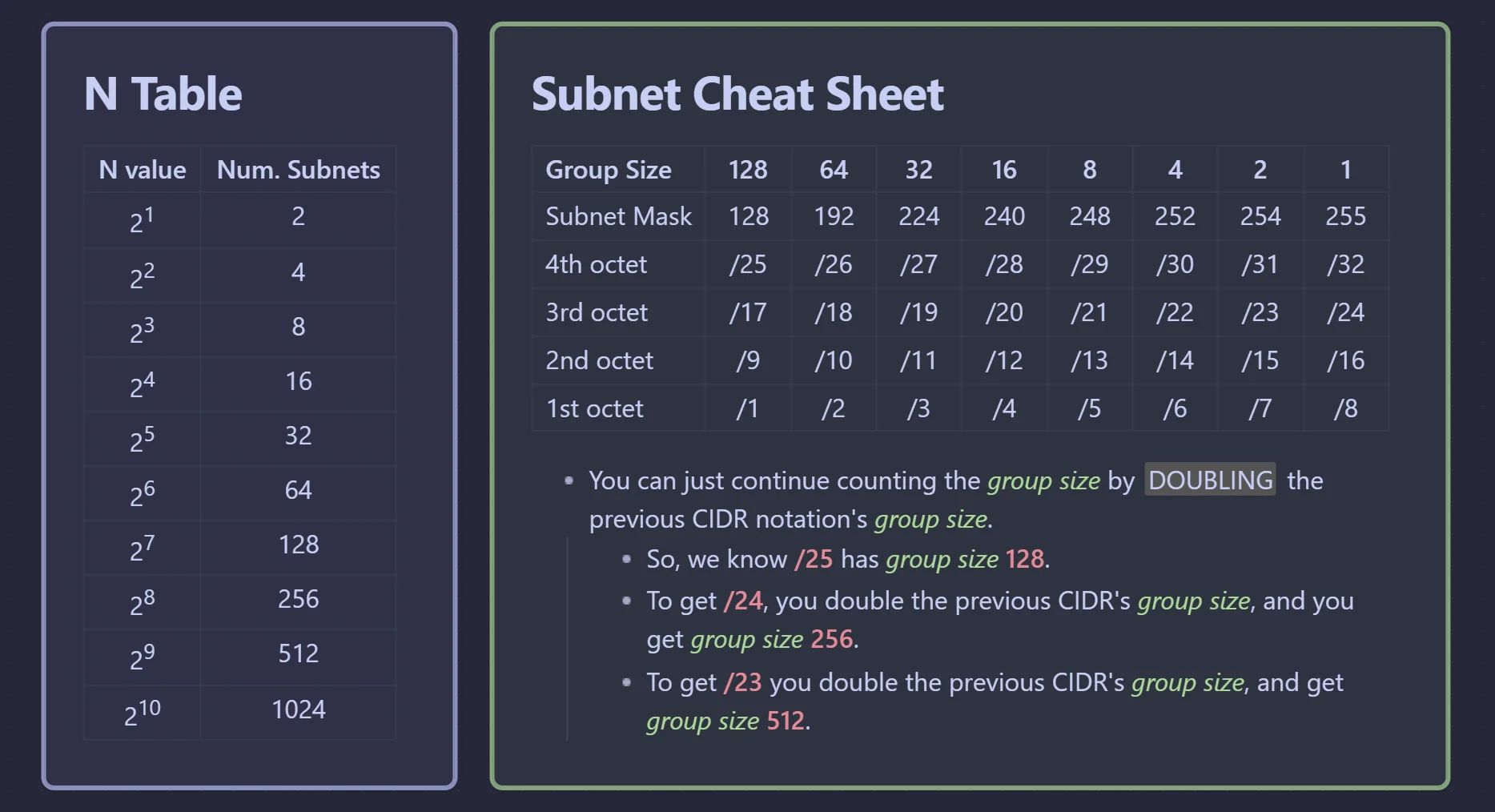
There are two types of questions for FLSM (Fixed-Length Subnet Masks), where you’ll be provided with two key pieces of information and you’ll have to solve for the third (As seen in the photos)
The best and easiest way to solve these questions would be to use the 2N table and the cheat sheet.
0.2. Cheat Sheet & N Table Image
Link to original
Two Question Types
There are two types of questions usually, being:
Question Type 1:
If you start with
/y, what size sub-network would you need to createXsub-networks?
/yis the given Subnet size.
Xis the amount of subnets we need to create.In this type of question you’d have to look through the sub-networks table for
X, and figure out theNin order to ADD it on top of/yExample 1:
- Ex: If you start with a
/18, what size sub-network would you need to create100sub-networks?
- For this question, you look for an
Nvalue which could contain 100 sub-networks. 100 specifically is not possible, so we’ll choose the next possible value which is 128 sub-networks, and theNvalue for 128 sub-networks is equal to7.- So, in order to get our sub-network size, we’ll add the given
/18andNvalue of7together to get/25and that’s the answer to the question.
- Equation: (
/18+7=/25)Example 2:
- Ex. If you start with a
/19, what size sub-network would you need to create100sub-networks?
- For this question, you look for an
Nvalue which could contain 100 sub-networks. 100 specifically is not possible, so we’ll choose the next possible value which is 128 sub-networks, and theNvalue for 128 sub-networks is equal to7.- So, in order to get our sub-network size, we’ll add the given
/19andNvalue of7together to get/26and that’s the answer to the question.
- Equation: (
/19+7=/26)Example 3:
- Ex. If you start with a
/20, what size sub-network would you need to create200sub-networks?
- For this question, you look for an
Nvalue which could contain 200 sub-networks. 200 specifically is not possible, so we’ll choose the next possible value which is 256 sub-networks, and theNvalue for 256 sub-networks is equal to8.- So, in order to get our sub-network size, we’ll add the given
/20andNvalue of8together to get/28and that’s the answer to the question.
- Equation: (
/20+8=/28)Example 4:
- Ex. If you start with a
/12, what size sub-network would you need to create15sub-networks?
- For this question, you look for an
Nvalue which could contain 15 sub-networks. 15 specifically is not possible, so we’ll choose the next possible value which is 16 sub-networks, and theNvalue for 16 sub-networks is equal to4.- So, in order to get our sub-network size, we’ll add the given
/12andNvalue of4together to get/16and that’s the answer to the question.
- Equation: (
/12+4=/16)Example 5:
- Ex. If you start with a
/10, what size sub-network would you need to create500sub-networks?
- For this question, you look for an
Nvalue which could contain 500 sub-networks. 500 specifically is not possible, so we’ll choose the next possible value which is 512 sub-networks, and theNvalue for 500 sub-networks is equal to9.- So, in order to get our sub-network size, we’ll add the given
/10andNvalue of9together to get/19and that’s the answer to the question.
- Equation: (
/10+9=/19)
Question Type 2:
- If you start with a
/y, how many sub-networks could you create that containXIP addresses?- Also comes as: If you start with a
/y, how many sub-networks could you create that were each/X?
/yis the given Subnet size.
Xis the amount of IP addresses.In this one you’ll have to reference the Practical Networking guide cheat sheet to figure out the sub-network size by looking at our
X, after we find it, we need to SUBTRACT it, using the formula:subnetworkSize - /y.
- The result of our subtraction will be the
Nvalue, from there we check the sub-network table to find the amount of sub-networks.( Type 1) Example 1:
- Ex. If you start with a
/20, how many sub-networks could you create that could contain50IP addresses?
- In this question, we need a sub-network size that would be able to fit 50 IP addresses. By looking at the cheat sheet we’ll find that it’s
/26which can contain 64 IP addresses.- Next step is to do the subtraction. The equation will be
/26 - /20resulting in6. Great, that’s ourNvalue.- Now, we look at our N Values table for
Nvalue:6and we find that 26 = 64- Therefore, we can have 64 sub-networks that could contain 50 IP addresses each.
( Type 1) Example 2:
- Ex. If you start with a
/21, how many sub-networks could you create that could contain50IP addresses?
- In this question, we need a sub-network size that would be able to fit 50 IP addresses. By looking at the cheat sheet we’ll find that it’s
/26which can contain 64 IP addresses.- Next step is to do the subtraction. The equation will be
/26 - /21resulting in5. Great, that’s ourNvalue.- Now, we look at our N Values table for
Nvalue:5and we find that 25 = 32- Therefore, we can have 32 sub-networks that could contain 50 IP addresses each.
( Type 1) Example 3:
- Ex. If you start with a
/22, how many sub-networks could you create that could contain50IP addresses?
- In this question, we need a sub-network size that would be able to fit 50 IP addresses. By looking at the cheat sheet we’ll find that it’s
/26which can contain 64 IP addresses.- Next step is to do the subtraction. The equation will be
/26 - /22resulting in4. Great, that’s ourNvalue.- Now, we look at our N Values table for
Nvalue:4and we find that 24 = 16- Therefore, we can have 16 sub-networks that could contain 50 IP addresses each.
( Type 2) Example 4:
- Ex. If you start with a
/22, how many sub-networks could you create that were each/30?
- In this question, our goal is to figure out the
Nvalue, as we’ll use it to find the number of sub-networks we can create.- We achieve this by taking our starting size of
/22and subtracting it from/30. This will give us anNvalue of8.
- Equation: (
/30-/22=8)- Now, we look at our N Values table for
Nvalue:8and we find that 28 = 256.- Therefore, we can make a total of 256 sub-networks.
Link to original( Type 2) Example 5:
- Ex. If you start with a
/10, how many sub-networks could you create that were each/16?
- In this question, our goal is to figure out the
Nvalue, as we’ll use it to find the number of sub-networks we can create.- We achieve this by taking our starting size of
/10and subtracting it from/16. This will give us anNvalue of6.
- Equation: (
/16-/10=6)- Now, we look at our N Values table for
Nvalue:6and we find that 26 = 64.- Therefore, we can make a total of 64 sub-networks.
Variable-Length Subnet Masks (VLSM)
6. VLSM - PracNet Subnet Guide
PracNet Subnet Guide - VLSM
Practical Networking’s Subnetting Mastery playlist
PracNet Subnetting - VLSM (Variable-Length Subnet Masks)
FLSM (Fixed-Length Subnet Masks)
- Up until now, we’ve been using FLSM (Fixed-Length Subnet Masks) to subnet our networks.
- This means that all of the subnets use the same prefix length.
- (ie. subnetting a class C network into 4 subnets using
/26).VLSM (Variable-Length Subnet Masks)
- VLSM (Variable-Length Subnet Masks) is where you make subnets of different (variable) sizes, in order to use your network addresses more efficiently.
VLSM Steps (Through PracNet)
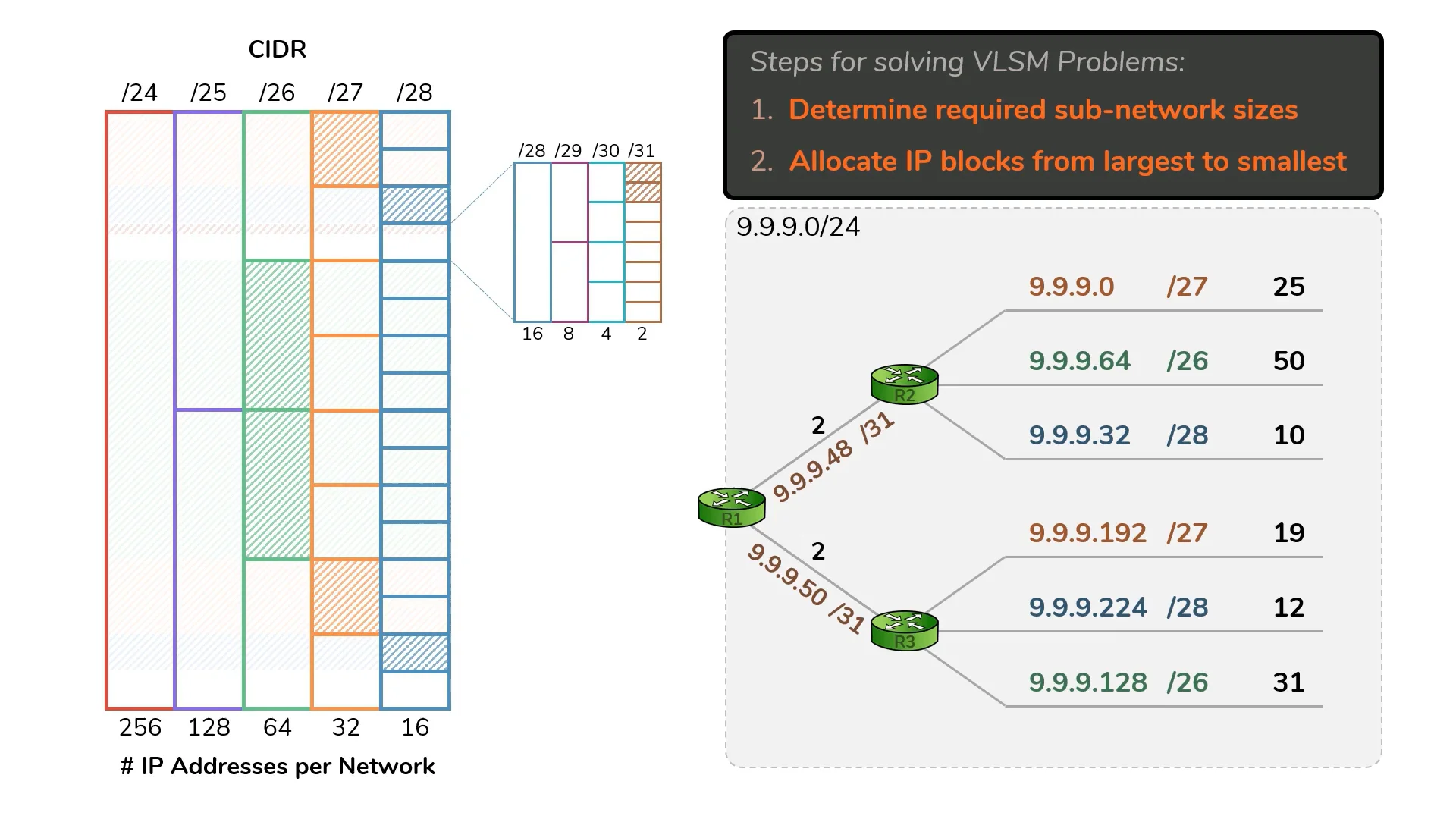
- Determine required sub-network sizes.
- Allocate IP blocks from largest to smallest (IP blocks is referring to the subnets that we’ve got).
PracNet’s Question and Answer
- PracNet solved R2’s subnet sizes inefficiently on purpose, in order to teach us how to use VLSM.
- R3’s subnet sizes were solved following steps 1 & 2.
- The point-to-point connection between R1-R2 & R1-R3 was solved using
/31, as it allows for 2 addresses if we don’t allocate a Network Address and Broadcast Address, however,/30would work as well. (According to Jeremy, it’s recommended to use/30in the exam.)
VLSM Steps (Through Jeremy’s IT Lab)
Despite the steps being a bit different, it’s still the same concept and VLSM is done the same way.
- Assign the largest subnet at the start of the address space.
- Assign the second-largest subnet after it.
- Repeat the process until all subnets have been assigned.
Jeremy’s Question and Answer My solution of the question in Inkodo:
- Additionally, I calculated the following variables in each subnet:
- Network Address
- Broadcast Address
- First Possible Address
- Last Possible Address
- Number of Usable Hosts
Link to original
My solution
VLSMSolution-PracNet-Subnet-guide---VLSM-20240316190140400.webp)
-MySolution---PracNet-Subnet-guide---VLSM-20240316190401547.webp)